
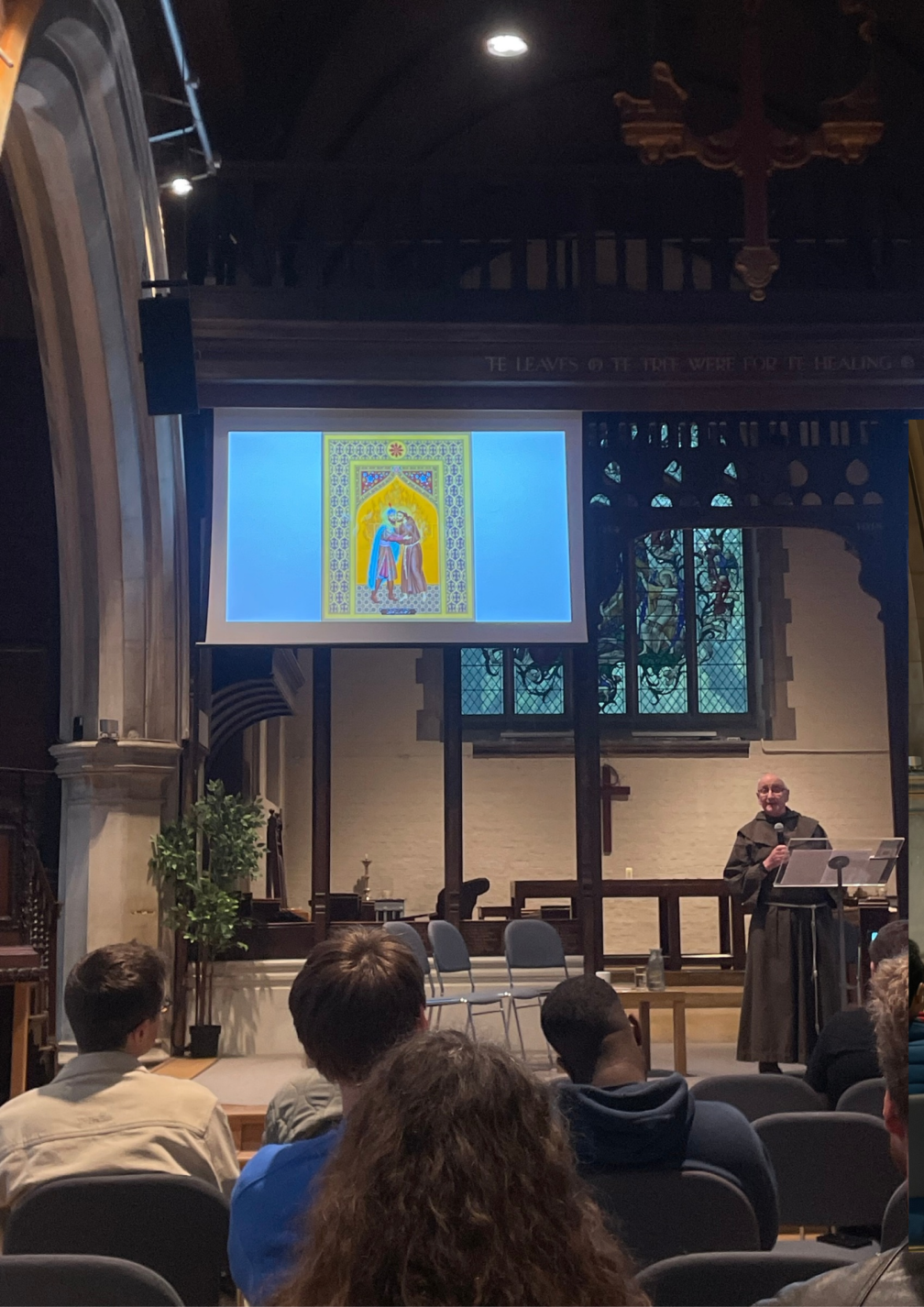
Anna and I recently attended a conference run by Better Story and Christian Aid titled ‘Loving Thy Neighbour in an Age of “Us” versus “Them”’. The conference explored how to live out this central parable in 2026. In a climate of polarisation and mistrust, how can we as Christians love our neighbour in a meaningful way? And how can the Church be a witness to God’s transformative love?
The conference was framed around the parable of the Good Samaritan, a well-known teaching for most people who have been practising the Christian faith for a while. It is told in response to the question, ‘Who is my neighbour?’, regarding the second greatest commandment: to ‘love thy neighbour as thyself’. Biblical parables invite us to insert ourselves into a story, and in this case, Christian teaching often prompts us to imagine ourselves as the Samaritan. We are encouraged to think about who we might find it easy to walk past, challenging us to love those who are different from us.
The parable, however, poses a far more radical idea. Jesus told the story to a Jewish man, an expert in the law. In this time period, Samaritans were commonly outcast by Jewish society and treated with religious and social hostility. In choosing a Samaritan as the hero, Jesus is therefore challenging a deeply entrenched assumption. The man who needed help belonged to the same group as the man Jesus told this story to. Jesus is therefore inviting him, and us, to imagine ourselves as the one in need of help, not just the one who can help others. He does not merely suggest that you should love your enemy (an already radical idea), but that your enemy may actually be loving. This means that the people about whom you have made assumptions because of their religious, ethnic, social or political identity may actually enact one of God’s greatest commandments.
Brother Sam, a Franciscan monk, put it this way: ‘To be a good host, you must first learn to be a good guest.’ Loving our neighbour in the context of the Columban mission requires us to humble ourselves and allow the hierarchies of our relationships to be transformed. This applies whether it is our relationship with the stranger, with members of other religious traditions, or with creation. We must understand that we are just as much in need of these relationships as they are of our service.
Brother Sam also quoted another scholar, proclaiming that ‘there is not a single person on this earth who cannot teach me something about the face of God’. That includes those who make choices you don’t agree with, who vote a different way to you, or who have hurt people that you love. To bear the image of God does not mean that someone’s behaviour is always reflective of God’s character, for sin is, of course, present in us all. It does mean, however, that within each person is revealed something unique about God. We must only be humble enough to see it.
