
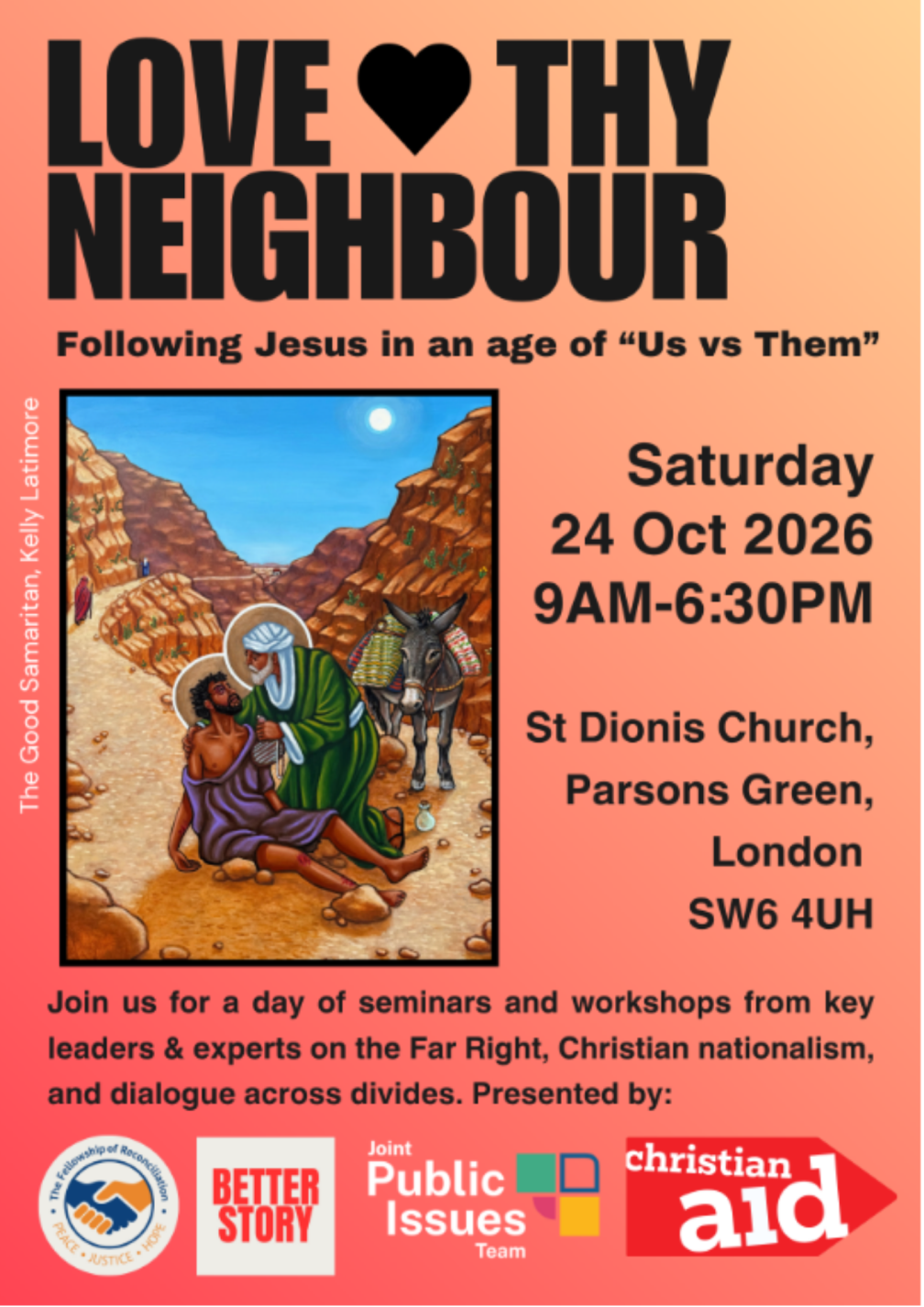
This conference made me really think about what “Us vs Them” means and the damage it can do. The conference started with a reflection by Tommy Sharpe on the story of the Good Samaritan, which resonated powerfully with me. He suggested that its core message is not simply to be kind to people who are different, which is what we might ordinarily hear, but to see those who are different from us, or think differently from us, as inherently kind. This challenges us to approach encounters with others who hold differing points of view with an open heart, as we try to see the good in them.
As he listed examples of those we consider “us and them”, I was struck by the inclusion of Christian nationalists and the far right as “them”. Often, when I think about othering, I think about refugees, people of colour and those who are part of the LGBTQ+ community, but not those we consider Christian nationalists or the “far right” (a term in itself which others). We need to reflect on this double standard: we cannot challenge the way some people are treated while doing the same to others, even if we believe we are working for ‘good’.
It made me think back to a vigil I attended a couple of weeks ago in Birmingham. It was meant to be about unity, but there was a fair amount of negative rhetoric aimed towards those who had come to counter-protest. At the time, I had wondered what good this was doing, but now, reflecting back, I think that it was actually doing a lot of harm. By alienating the other and shouting harmful slogans, we become no better than them. While, in this situation, I am unsure what the best response would have been, I think that generally trying to see the innate good in all people is what we are called to do as Christians. We attempted to do this by handing out paper doves as a sign of peace to those standing watching, and I hope that the people who received those doves might have felt we were reaching out in some way and valuing them.
After the introduction, we moved to the panel discussion, which engaged with the question: “Why are Christians engaging with the far right?” It really got me thinking about community and how, as churches, we are called to create communities where everyone is truly welcome. This is no easy feat, and it can often feel uncomfortable to have people in our churches with whom we don’t agree. But if we are to live out the true biblical welcome, we need to welcome all. We cannot expect those who are part of communities where far-right ideology is present to drop it all if they have no alternative community to join where they will be truly welcomed.
Leading on from this, in a session run by the Red Letter Christians, I wrote a beatitude which I think reflects on this lament and hope.
Now is the time for a church that practises a radical welcome, where the gays, the refugees, the trans* people, the Christian nationalists, the Muslim, the doubter, the disabled person and the black person can walk through the door.
Time’s up for a church that puts up walls, preventing people from walking through the door and making it a place where Jesus would feel like a stranger.
I was then able to reflect on these ideas further as Revd Dr. Israel Olofinjana explored ideas of Polyphonic Theology through his talk. His distinction between English-English and English-multicultural made me reflect further on who is welcome in our churches and how we view non-white British people in that space. He asked the question: “Are we asking people to become more English or be more like Christ?” This got me thinking about the cultural expectations that we place on people in churches, particularly the balance between helping people adjust to life in the UK and giving them a space where they can be themselves without feeling they have to censor themselves.
This idea of welcome without expecting change led into the next talk by Brother Sam, who explored the Christian approach to encountering people of other faiths. He explored the example of St. Francis, who went to encounter others thinking he would find an enemy but actually found a friend. This returns to the idea of “Us vs Them”, which I think, as Christians, we can sometimes hold unconsciously as we encounter people of other faiths.
Brother Sam reminded us that we don’t own Christ, but that we belong to him, and that as Christians we need to keep the ninth commandment: “Thou shalt not bear false witness against thy neighbour.” From this, he suggested that we need to challenge false ideas that we hear about other religions in the world. This led into the talk given by the CEO of Tell MAMA, a charity that records incidents of anti-Muslim hate. She urged us, as Christians, to live out our calling to be good neighbours and to stand up for those being abused by reporting anything we see.
So, to conclude, this was a very thought-provoking conference, which I will be reflecting on for many days to come. There are three main points I will be mulling over. Firstly, othering works both ways. We need to make sure that we don’t fall into the trap of othering those we disagree with and that we see them as inherently good. Secondly, the Church needs to offer an alternative community where all truly feel welcome. Finally, we are called, as Christians, to stand up for people of other faiths. This means not treating them as others but looking to build relationships.
