At 2024’s Columban General Assembly, the gathered representatives and leaders of Columbans around the world discerned a commitment to two ‘mission priorities’: MIGRANTS and REFUGEES, and BIODIVERSITY PROTECTION and RESTORATION. Both are ‘hot topics’ in the world today, in politics, in papal encyclicals, on social media and in the news.
As the Justice and Peace Education Worker for the Columban’s in Britain, I often find myself using statistics, in combination with scripture and Catholic Social Teaching, to give context to issues related to these mission priority areas. Much of this data comes to me second or third hand, usually from charities. So when an email arrived in my inbox inviting me to attend the Office for National Statistics’ Migration Statistics User Forum, it seemed a good idea to say “yes”. I could have a better understanding of the ‘Lies, damned lies and statistics’ (a quote (mis)attributed to many people, including Benjamin Disraeli and Mark Twain).
The morning I attended (online) was made up of impressively high level inputs and discussion, with presentations from statisticians and analysts from the Home Office, the Office of National Statistics and the Migration Observatory. It helped me understand something of the hard work and deep thinking that goes into collecting and understanding data concerning immigration and emigration. The presenters made clear that their methods were non-political, with research being given to politicians only 24 hours before being released publically. Jack Cooper, Head of Migration Statistics at the UK Home Office, explained the importance of migration data: “ensuring that people have the facts, to support sensible conversation”, helping them to understand what goes on beyond the headlines.
There were three bits of data that really struck me:
- Total immigration is falling
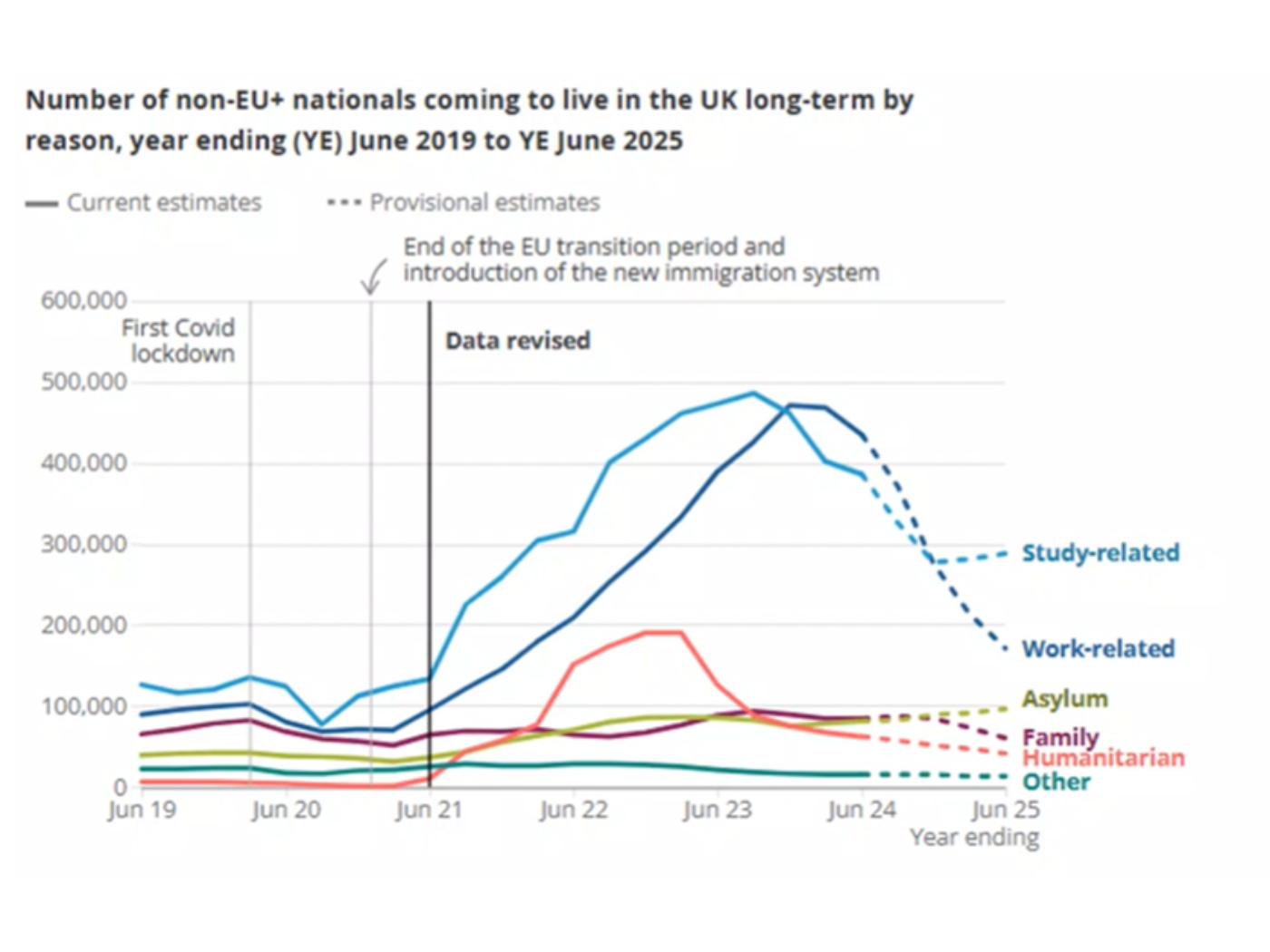
Given media narratives about Britain being ‘full’ and the general panic about migration, this statistic surprised me. Long term immigration to the UK peaked in 2023 and continues to fall. At the same time emigration, people moving out of the UK, is rising.
- Less than half of the people seeking asylum in the UK arrive in small boats
I have no doubt that if I polled people on the high street (or students in a school) they would confidently assert that small boats are the usual way refugees arrive in Britain. This is reflected in or reflects successive governments’ policies around ‘stopping the boats’ and ‘securing borders’. Again, this statistic is contrary to the dominant narrative which raises questions. - How small asylum numbers are relative to the total immigration numbers
The majority of people coming the UK long term do so for study or work, both of which provide economic benefits to the country.
But how important are facts? Can statistics change people’s hearts and minds, or even “support sensible conversation”? While I have no doubt they have a part to play, they are clearly not enough. In recent years we have witnessed a fascinating and disconcerting turn away from expertise. Large groups of people seem to be willing to reject and ignore truth that doesn’t suit them, the feelings they have or the beliefs they hold.
During the research that led to my now almost completely forgotten PhD, I became more and more convinced that story, encounter and experience are crucial to people’s engagement with movements for social justice. This is reflected in the contributions I have the privilege of making to Columban mission in Britain. Examples include facilitating encounters between educators and people seeking sanctuary in Britain, creating moments for nature connection in the rewilding project at St Columban’s in Solihull, and arranging online meetings with individuals and communities around the world on the front line of the climate and biodiversity crises. When these are supported by a well-thought through pedagogical process, including the wider context, relevant statistics, prayer and reflection, they can make a difference. My experience is that in this way people begin to challenge misconceptions, connect to the issues and put their faith into action on our mission priority areas.