
Last April, Italian architect Manuela Bertoncini visited the home of the Columban Missionaries in Ireland. in the shadow of the statue of St. Columbanus at the Mission Exhibition in Dalgan she recalled how the Peregrinus Project, which builds cross-border partnerships, student exchanges, and cultural networks between Ireland, Northern Ireland, Italy, and France, began in 2012. The project has twinned schools and arranged exchange visits between students in Italy and Ireland with the help of groups affiliated to the Columban Way, such as the Friends of Columbanus Bangor.
The Peregrinus Project aims to ensure that the ancient concept of peregrinatio (living away from one’s homeland for a higher purpose) and the legacy of St. Columbanus and the monks who travelled across Europe more than 1,400 years ago remain relevant. Project participants learn about local projects focused on climate change and biodiversity, as well as the mapping out of pilgrim routes.
Manuela has her own personal connection to St Columbanus through the 12th century Romanesque church dedicated to the Irish missionary, as is another old abbey in the locality. “I grew up in Liguria because my father was working in the Italian Air Force but I spent all my summers in Vernasca.” As a child she “never cared” much about the fact that this ancient church was dedicated to San Colombano. That changed in September 2011, when Manuela organised an international conference on medieval history in Vernasca.
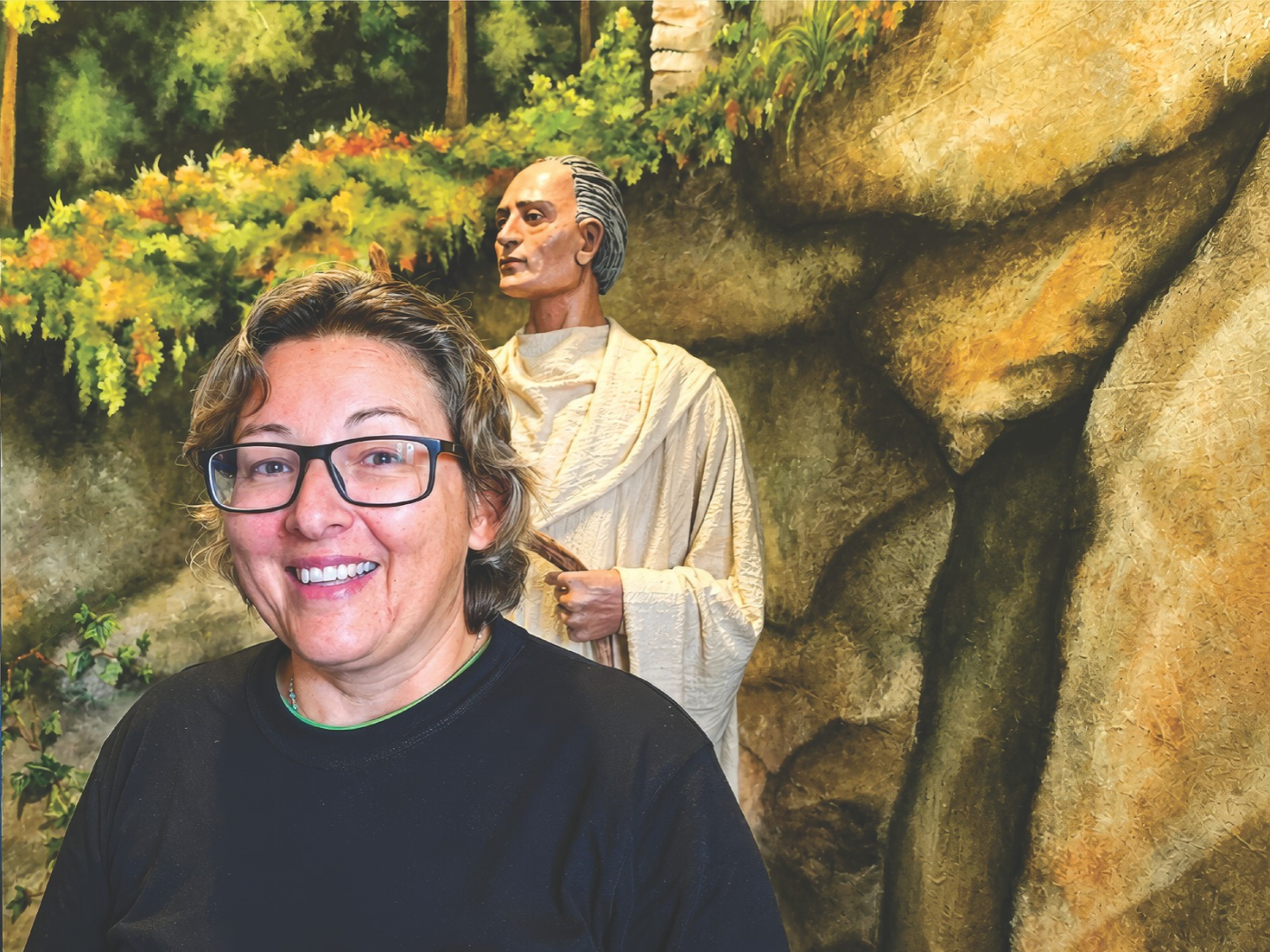
Her professional background is in art and architecture, including the restoration of ancient buildings and traditional construction techniques. She also has longstanding connections with Ireland as she learned English in Cork in 1997 and spent eight months studying at the School of Architecture in Bolton Street, Dublin, as an Erasmus student in 2002. There she met Brendan Grimes, who taught architectural history. She returned to Ireland in 2006 as an exchange researcher between Ireland and Italy. Her research was going well, and she had been encouraged to develop it into a PhD but events in her personal life took her in another direction.
Her fiancé, who was serving in the Italian Army, went to Afghanistan. Five friends were lost within five months and the trauma of that prompted her to return to Italy and marry him. The couple moved to Aosta and they had two sons, Leonardo and Edoardo. Years later, when she organised a conference in the old abbey in Vernasca in 2011, she invited Brendan Grimes to participate. He spoke about the Irish monastic movement, while the local parish priest discussed the influence of monks who had come to Vernasca and established a monastery. For Manuela, it was a turning point. “I was listening, and it was like a window opened in my mind,” she said.
“I think in my heart I found something that I didn’t know I was looking for,” she said. In Ireland, she sought advice from people she had known through architecture. With James Horan and Brendan Grimes from Bolton Street, she travelled to Bangor where they explored the story of Columbanus and the connections surrounding him. This led them to found a small cultural association in 2012. They also began meeting other organisations dedicated to studying Columbanus, including groups in Luxeuil in France, Bobbio and San Colombano al Lambro in Italy.
The question driving the work was why somebody who lived 1,400 years ago should continue to matter. For the association, part of the answer was found in the idea of a shared European community. That thinking developed into the Peregrinus Project. “The name Peregrinus reflected the idea,” Manuela explained, “That every person is a traveller during their time on this earth.”
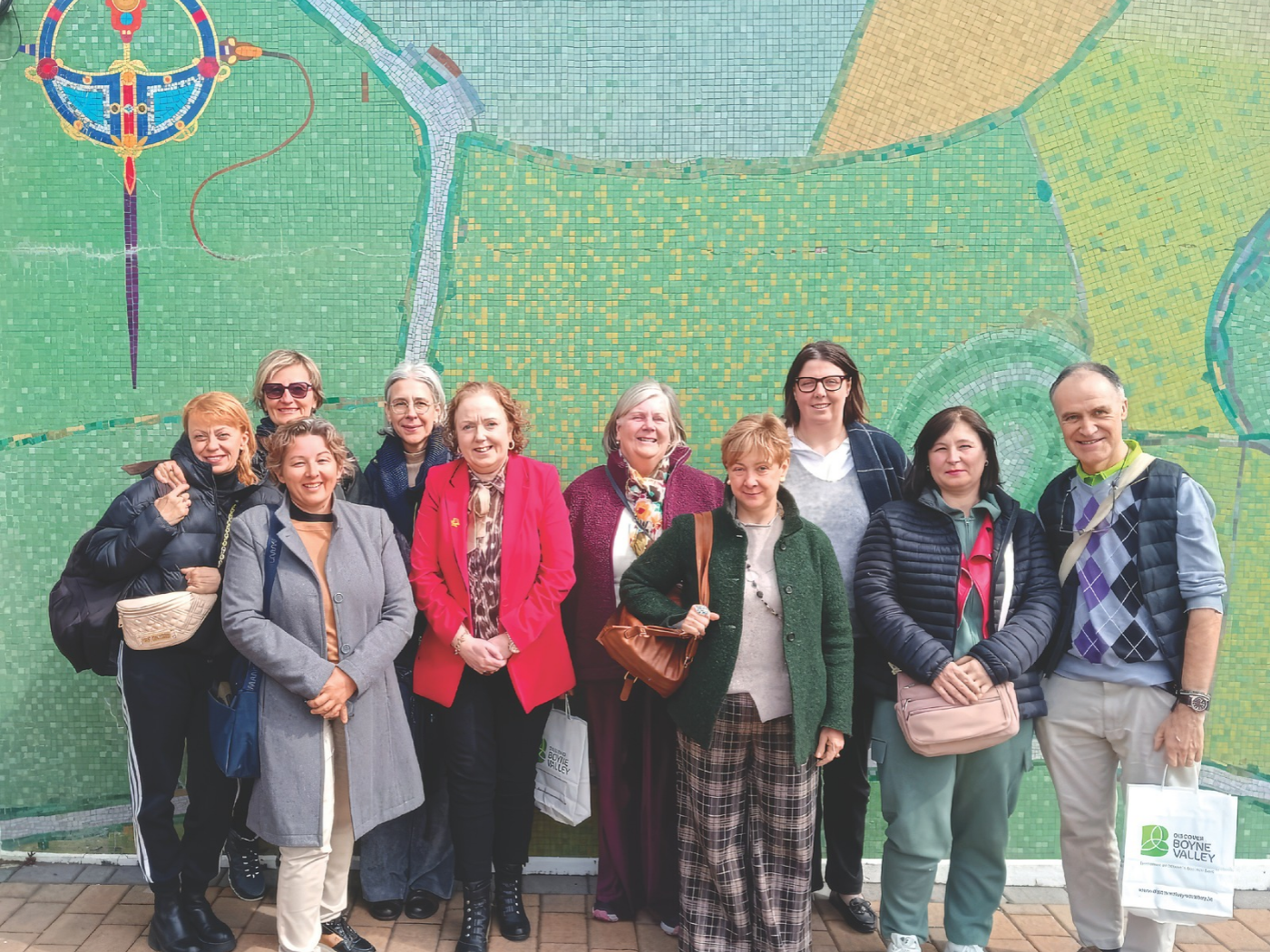
The group created 12 pieces of roofing slate, each carved with the arch of a bridge and a letter. Over three years, from 2013 to 2015, campervans travelled from Italy to Ireland along the route associated with Columbanus, carrying the slates. The symbols were left at 12 locations across seven countries and spelt ‘Totius Europae’, concluding at the Abbey of St Columbanus in Bobbio, where the saint died in 2015.
The association’s work subsequently expanded into sport and education, with schools becoming increasingly important to the project, which was shaped by what Manuela saw as lessons from Columbanus and his companions. For example, when speaking to schoolchildren, she tells them that the monks crossed Europe during dangerous times without carrying weapons. Instead, they carried knowledge and relied on diplomacy and dialogue while working with the land and restoring buildings.
This educational message includes respect for nature and the importance of people working together rather than waiting for others to solve problems. For Manuela, bringing Italian students to Ireland also highlights how much Europeans can still learn about one another. “We are all Europeans, but we still dedicate more time and energy to discover our brothers and sisters, our neighbours,” she said. “This is something we have to work hard on.”
Her own relationship with the project has continued despite personal challenges. She said she suffered brain ischaemia in 2018, underwent a heart procedure the following year and had two cancer operations in 2022. She also lives with fibromyalgia. “Faith is what helped me to stand, you know, to keep going,” she said.
She also stresses that the Peregrinus project has been made possible by people in many different places and with different political opinions and backgrounds. “It’s a human, deep connection that is driving this project,” she said. “There are so many people who have given, each one, his own contribution to make this real. Otherwise, it would be only a dream.”