
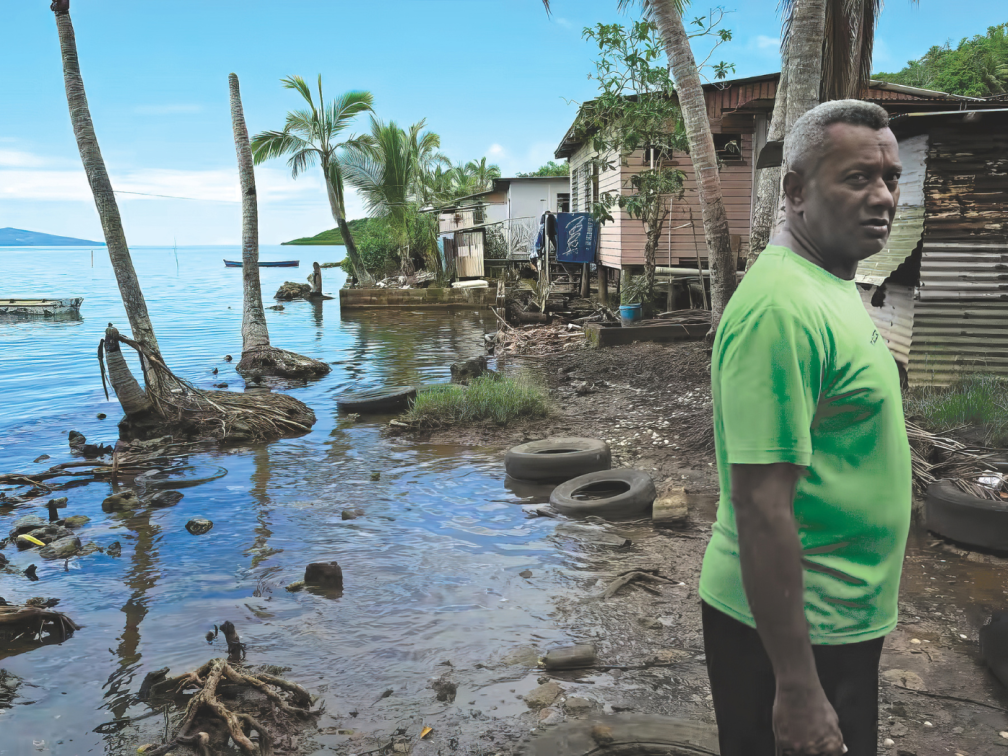
Columbans have been ministering in the Pacific Islands since 1952, after the Society’s expulsion from newly communist China. A very large feature of life there is the climate, which both attracts sunshine-deprived tourists, but can also wreak havoc through hurricanes, floods and droughts, the incidence and unpredictability of which have recently increased.
A feature article by Katie McQue of the respected journal New Scientist (17th Jan 2026) related how rising seas and intensifying storms in Tonga, Fiji and Samoa are already “having a devastating effect on people’s livelihoods, health and well-being and that in some cases, the threat is truly existential. Tuvalu, comprising nine low-lying islands halfway between Hawaii and Australia, could be almost completely submerged at high tide by the end of the century”.
Pacific Island nations, which account for less than 1% of global emissions, have an average elevation of 1-2 metres above sea level, with 90% of their population living within 5kms of the coast and half the infrastructure (roads, bridges, schools) located within 500m of it. A “perfect storm” for the uniquely exposed 10 million people who call the islands their “vanua”, their home.
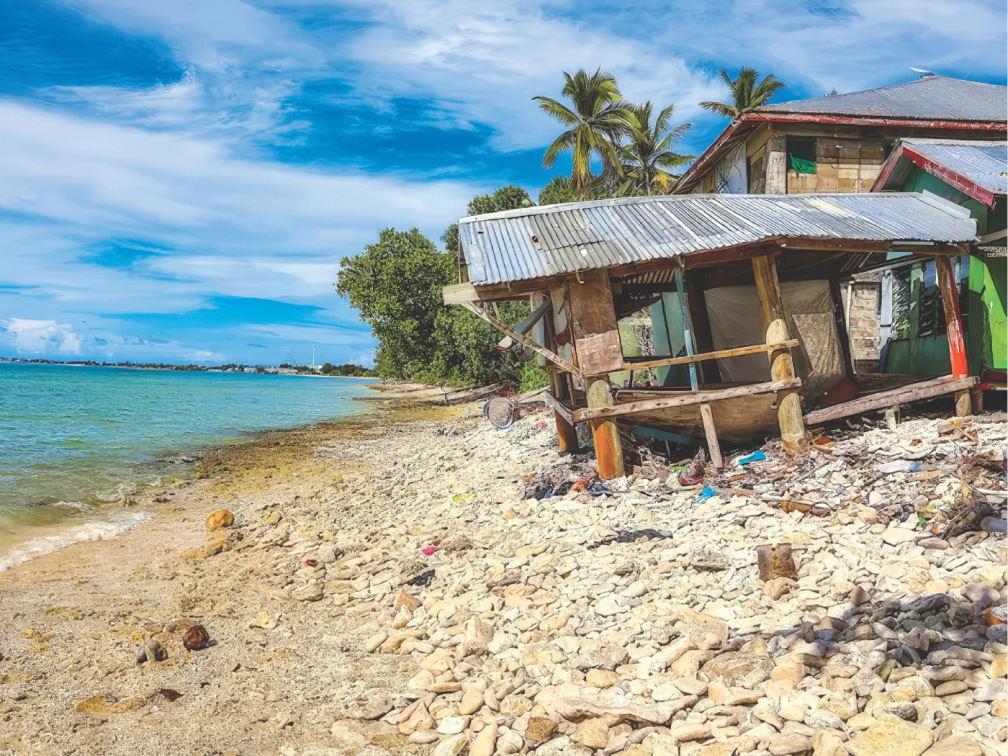
From my own time in Fiji from 1995 until 2023, I never lived more than 1km from the sea, and in some cases, I was right on the coast. I have seen coastal erosion, one home or garden plot at a time. In the Formation House in Suva, we regularly ate the coastal crabs we caught in our garden, while root crops generally could not survive the increasingly saline soil.
There were many days where sea-swimming was more akin to taking a sauna! On the macro-level, increasing ocean temperatures are killing off coral reefs and depleting fish stocks, while higher land temperatures lead to mosquitoes going further inland, with many Fijians succumbing to the dengue fever the insects often bring. Some of my saddest funerals in the coastal parish of Ba were of schoolchildren who died from dengue, as well as young farmers or fishermen perishing from leptospirosis, particularly following the floods and heavy rain Fiji gets annually from November to April.
Conversely, more frequent and severe dry spells (from May-October) have intensified the pressure on freshwater supplies, food and public health. Ironically, the country continues to export millions of gallons of premium bottled water (‘FIJI Water’), extracted from a high-quality aquifer in the Yaqara Valley (near Ba) for global export, often creating a stark contrast with local water shortages.
With ocean warming, food security becomes a huge issue; there is a lack of reef fish and an increasing reliance on ultra-processed food (the iconic example being the low-grade, high fat, tinned mutton or beef, unsold in Australian/New Zealand shops and ‘repackaged’ as a cheap staple or ‘aid’ in times of natural disaster.
All these problems overlap, and inevitably, climate migration follows. On Abiang Atoll in Kiribati, for example, the village of Tebunginako has been fully relocated inland; and 280 Tuvaluans are to be granted Australian citizenship each year through a ballot system. Nearly half the country’s 10,000 residents have applied.
Many of the islands are seeing surges of seasonal workers leaving their shores due to the economic pressures. Fiji has become the largest supplier of workers to Australia’s Pacific ‘Australia Labour Mobility’ (PALM) scheme, with over 6,379 workers as of mid-2024, a dramatic rise from only 266 in 2019.
Combined with New Zealand’s ‘Recognised Seasonal Employer’ (RSE) scheme, total Fijian seasonal worker numbers surpassed 15,000 in late 2025. This is quite stunning, given an overall population of just over 900,000. Many teachers, social workers and pastoral agents in the islands describe the destabilising effect of the absence of young parents in villages and towns, with children often unsupervised, vulnerable to online or peer recruitment as drug couriers to locals and tourists, and the loss of culture, language and faith that nature intended be transmitted through parents and older siblings.
There are of course, some signs of hope. Many villages, unable to afford large-scale coastal engineering, are turning to nature-based interventions, such as the restoration of mangrove swamps. Healthy swamps not only prevent further land loss but safeguard fish and crab stocks. The biggest obstacle is obtaining finance at the scale necessary for climate resilience.
In July 2025, the International Court of Justice declared that states have a binding legal duty to protect the climate system and assist vulnerable countries to adapt to the impacts of climate change. This grew from a campaign led by Vanuatu and other Pacific Island nations, who argued that existing climate commitments were too weak to safeguard their survival. To date, though, the Pacific Region has only been able to access about 0.22% of global climate funds.
For the people of the Pacific, it is not a matter of “adapt to thrive”, it is a matter of “adapt to Survive”. How truly catastrophic it would be to literally see whole ways of life drowning in the sea on our watch. In 2018, Archbishop Peter Loy Chong of Fiji launched a ‘Climate Change Victims’ Lament’ with its haunting lyrics: “Earth is ravaged by our hand.. Oceans weep for beauty lost… Have mercy, have mercy, have mercy on us, Lord”.
At a time when the world seems endlessly convulsed with wars designed by humans against each other, let us not lose sight of the deadly attack we have also launched on our Mother Earth. Without Her sustenance, there will be no ‘land’, ‘rights’, or ‘principles’ to fight over. In his speech at the ‘Raising Hope’ Conference for the 10th anniversary of Laudato Sí, Pope Leo posed this challenge: “God will ask us if we have cultivated and cared for the world that he created for the benefit of all and for future generations, and if we have taken care of our brothers and sisters. What will our answer be?”
Fr. Pat Colgan is from Belfast. He was ordained in 1994 and spent 18 years in Fiji before he was appointed to the Society’s General Council in 2012. He returned to Fiji in 2018. He is now based in Ireland.
